









- Focus and Scope
- Section Policies
- Peer Review Process
- Publication Frequency
- Open Access Policy
- Archiving
- Plagiarism Checker
- Publication Fee
- Publication Ethic
- Abstracting & Indexing
Focus and Scope
Focus and Scope
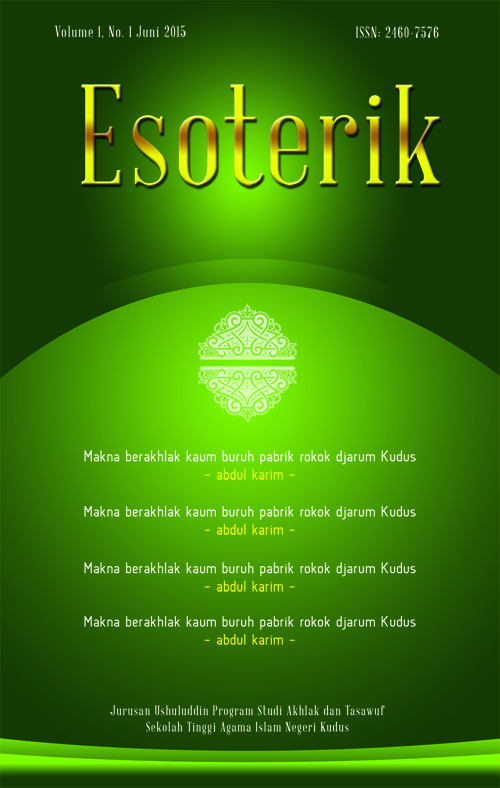
ESOTERIK: Journal of Akhlak and Tasawuf welcomes scholarly articles based on textual research, fieldwork, and interdisciplinary approaches that contribute to the advancement of knowledge in Sufism, Islamic mysticism, spirituality, and their related fields. The journal encourages diverse theoretical, methodological, and critical perspectives, covering the following areas:
Sufism (Tasawuf): Sufi thought, doctrines, teachings, intellectual traditions, and historical developments.
Islamic Mysticism: Mystical traditions in Islam, including critical and comparative perspectives, as well as Orientalist approaches to the study of Sufism.
Sufistic Psychology: Islamic perspectives on the human psyche, spiritual experience, and the development of psychological thought within Sufi traditions.
Sufistic Psychotherapy: Theoretical and practical approaches to psychospiritual healing, Islamic psychotherapy, Sufi healing, and their contemporary developments.
Spirituality: Spiritual values, experiences, practices, and their relevance to human life, personal transformation, and well-being.
Sufi Orders (Tariqa): The teachings, practices, institutional structures, social roles, and historical development of Sufi orders.
Related Interdisciplinary Studies: Other scholarly fields and emerging issues that intersect with Sufism, spirituality, and Islamic intellectual traditions.
The journal particularly welcomes original and rigorous scholarship that advances critical inquiry, fosters interdisciplinary dialogue, and demonstrates the relevance of Sufism and spirituality to contemporary intellectual and societal challenges.
Section Policies
Articles
 Open Submissions |
Indexed |
Peer Reviewed |
Peer Review Process
Review Policy
ESOTERIK: Journal of Akhlak and Tasawuf applies a double-blind peer-review system to maintain the quality, objectivity, and integrity of its publications. The identities of authors and reviewers are kept confidential throughout the review process.
All submitted manuscripts undergo an initial editorial screening to assess their suitability for the journal's focus and scope, originality, compliance with the author guidelines, and academic quality. Manuscripts that pass the initial screening are evaluated by at least two independent reviewers with relevant expertise in the subject matter.
Reviewers assess manuscripts based on originality, relevance, theoretical contribution, methodological rigor, quality of analysis, clarity of presentation, engagement with relevant literature, and ethical compliance. Reviewers provide constructive comments and recommendations to assist the editor in making an informed editorial decision.
Based on the reviewers' reports and the editor's assessment, a manuscript may be accepted, accepted subject to revision, returned for further revision, or rejected. The editor retains responsibility for the final publication decision.
Reviewers must maintain the confidentiality of submitted manuscripts, disclose potential conflicts of interest, and conduct their evaluations objectively and professionally. The journal does not permit the use of confidential manuscript content for personal or professional advantage.
The peer-review process is conducted in accordance with the journal's publication ethics principles and applicable scholarly publishing standards.
Review Guidelines
Reviewers are expected to evaluate submitted manuscripts objectively, critically, and constructively. Their assessment should help the editor determine the manuscript's suitability for publication and assist authors in improving the quality of their work.
Reviewers are requested to consider the following aspects:
Originality and Contribution: Does the manuscript offer an original contribution to scholarship in its field?
Relevance and Scope: Is the manuscript relevant to the focus and scope of ESOTERIK: Journal of Akhlak and Tasawuf?
Theoretical and Conceptual Framework: Is the theoretical foundation appropriate, coherent, and adequately supported by relevant literature?
Methodology: Are the research design, methods, data collection, and analytical procedures appropriate and clearly explained?
Results and Discussion: Are the findings presented clearly, analyzed rigorously, and interpreted in relation to the research questions and existing scholarship?
References: Are the references relevant, sufficiently current where appropriate, and accurately cited?
Clarity and Organization: Is the manuscript logically structured and written in clear academic language?
Research and Publication Ethics: Are there any concerns regarding plagiarism, research integrity, ethical approval where applicable, data reliability, or conflicts of interest?
Reviewers should provide specific, evidence-based comments and distinguish major concerns from minor revisions. Personal criticism of the authors is inappropriate.
Reviewers should submit their recommendations using the journal's designated review form or the review fields provided in the journal's submission system. Recommendations may include acceptance, minor revision, major revision, or rejection, subject to the journal's editorial decision categories.
Confidential comments intended only for the editor should be entered in the designated confidential field and should not be included in comments intended for the authors.
Reviewers must treat manuscripts as confidential documents, disclose any potential conflicts of interest, and inform the editor if they suspect plagiarism, redundant publication, or other ethical concerns. Reviewers should decline the assignment if they lack the necessary expertise or cannot complete the review within the specified timeframe.
Publication Frequency
The ESOTERIK Journal is a journal published by the Department of Sufism and Pyschotherapy Program of Ushuluddin IAIN Kudus with Konsorsium Tasawuf dan Psikoterapi Indonesia (Kotaterapi). This journal is published twice a year.
Open Access Policy
This journal provides immediate open access to its content on the principle that making research freely available to the public supports a greater global exchange of knowledge.
Archiving
This journal utilizes the LOCKSS system to create a distributed archiving system among participating libraries and permits those libraries to create permanent archives of the journal for purposes of preservation and restoration. More...
Plagiarism Checker
Esoterik Journal use both Viper plagiarism checkher software and web based plagiarism checker like Grammarly.com, plagscan.com.
Publication Fee
All processes of article publication are free of charge.
Publication Ethic
Esoterik: Jurnal akhlak dan Tasawuf is a peer-reviewed journal, published twice a year by Program Studi Tasawuf dan Psikoterapi Fakultas Ushuluddin, Universitas Islam Negeri (UIN) Sunan Kudus Indonesia collaborated with Konsorsium Tasawuf dan Psikoterapi Indonesia (Kotaterapi). It is available online as open access sources as well as in print. This statement clarifies ethical behavior of all parties involved in the act of publishing an article in this journal, including the author, the editor-in-chief, the Editorial Board, the reviewer, and the publisher. This statement is based on COPE’s Best Practice Guidelines for Journal Editors.
Ethical Guideline for Journal Publication
The publication of an article in Esoterik: Jurnal akhlak dan Tasawuf is an essential building block in the development of a coherent and respected network of knowledge. It is a direct reflection of the quality of the work of the authors and the institutions that support them. Peer-reviewed articles support and embody the scientific methods. It is therefore important to agree upon standards of expected ethical behavior for all parties involved in the act of publishing: the author, the editor, the reviewer, the publisher, and the society. As the publisher of Esoterik: Jurnal akhlak dan Tasawuf, Program Studi Tasawuf dan Psikoterapi Fakultas Ushuluddin, Universitas Islam Negeri (UIN) Sunan Kudus Indonesia collaborated with Konsorsium Tasawuf dan Psikoterapi Indonesia (Kotaterapi) takes its duties of guardianship over all stages of publishing seriously and it recognizes its ethical and other responsibilities. Program Studi Tasawuf dan Psikoterapi Fakultas Ushuluddin, Universitas Islam Negeri (UIN) Sunan Kudus Indonesia committed to ensuring that advertising, reprint or other commercial revenue has no impact or influence on editorial decisions.
Publication Decisions
The editors of Esoterik: Jurnal akhlak dan Tasawuf is responsible for deciding which articles submitted to the journal should be published. The validation of the work in question and its importance to researchers and readers must always drive such decisions. The editors may be guided by the policies of the journal's editorial board and constrained by such legal requirements as shall then be in force regarding libel, copyright infringement, and plagiarism. The editors may confer with other editors or reviewers in making their decisions.
Plagiarism Screening
It is basically author’s duty to only submit a manuscript that is free from plagiarism and academically malpractices. The editor, however, double checks each article before its publication. The first step is to check plagiarism against offline database developed by Program Studi Tasawuf dan Psikoterapi Fakultas Ushuluddin, Universitas Islam Negeri (UIN) Sunan Kudus Indonesia, secondly, against as much as possible online databases and use plagiarism checker software.
Fair Play
An editor at any time evaluates manuscripts for their intellectual content without regard to race, gender, sexual orientation, religious belief, ethnic origin, citizenship, or political philosophy of the authors.
Confidentiality
Editors and any editorial staff must not disclose any information about a submitted manuscript to anyone other than the corresponding author, reviewers, potential reviewers, other editorial advisers, and the publisher, as appropriate.
Disclosure and Conflicts of Interest
Unpublished materials disclosed in a submitted manuscript must not be used in editors' own research without the express written consent of the author.
Post-Publication Discussion Policy
ESOTERIK: Journal of Akhlak and Tasawuf welcomes scholarly comments, constructive criticism, and academic responses to published articles. Submissions must be evidence-based, relevant to the journal's scope, and consistent with publication ethics. The editorial team will evaluate submissions and may invite the original authors to respond. Accepted discussions will be published at the editor's discretion.
Correction and Retraction Policy
ESOTERIK: Journal of Akhlak and Tasawuf is committed to maintaining the accuracy and integrity of the scholarly record. Corrections may be issued for errors that do not invalidate an article's main findings, while expressions of concern may be published when significant issues remain unresolved. Retractions may be issued in cases involving unreliable findings, plagiarism, redundant publication, data fabrication or falsification, or serious ethical violations.
Suspected errors or ethical concerns may be reported to the editorial team. The editor will assess the evidence, provide authors with an opportunity to respond where appropriate, and take action in accordance with publication ethics principles and relevant Committee on Publication Ethics (COPE) guidance. All corrections, expressions of concern, and retractions will be clearly identified and linked to the original article.
Duties of Reviewers
Contribution to Editorial Decisions
Peer review assists the editors in making editorial decisions and through the editorial communications with the authors may also assist the author in improving the quality of the paper.
Promptness
Any selected referee who feels unqualified to review the research reported in a manuscript or knows that its prompt review will be impossible should notify the editors and excuse himself from the review process.
Confidentiality
Any manuscripts received for review must be treated as confidential documents. They must not be shown to or discussed with others except as authorized by the editor.
Standards of Objectivity
Reviews should be conducted objectively. Personal criticism of the author is inappropriate. Referees should express their views clearly with supporting arguments.
Acknowledgement of Sources
Reviewers should identify relevant published work that has not been cited by the authors. Any statement that an observation, derivation, or argument had been previously reported should be accompanied by a proper citation. A reviewer should also call to the editors' attention any substantial similarity or overlap between the manuscript under consideration and any other published paper of which they have personal knowledge.
Disclosure and Conflict of Interest
Privileged information or ideas obtained through peer review must be kept confidential and not used for personal advantage. Reviewers should not consider manuscripts in which they have conflicts of interest resulting from competitive, collaborative, or other relationships with any of the authors, companies, or institutions related to the papers.
Review Process
Every manuscript submitted to Esoterik: Jurnal akhlak dan Tasawuf is independently reviewed by at least two reviewers in the form of "double-blind review". Decision for publication, amendment, or rejection is based upon their reports/recommendation. In certain cases, the editor may submit an article for review to another, third reviewer before making a decision, if necessary.
Duties of Authors
Authorship Criteria
ESOTERIK: Journal of Akhlak and Tasawuf requires authorship to reflect substantial contributions to the research and manuscript. All individuals listed as authors must have made meaningful contributions to the conception or design of the study, data collection, analysis or interpretation, or the development of the manuscript.
All authors must participate in drafting or critically revising the manuscript, approve the final version for publication, and take responsibility for the integrity and accuracy of their contributions. Individuals who have contributed to the research but do not meet the authorship criteria should be acknowledged appropriately, with their consent.
The corresponding author is responsible for ensuring that all eligible authors are listed, that the author order is agreed upon by all authors, and that all authors approve the submitted manuscript. Any changes to authorship after submission must be justified and approved by all authors, subject to the editor's decision.
Honorary, guest, or ghost authorship is not permitted. All authors must disclose relevant conflicts of interest and comply with the journal's publication ethics policies.
Reporting Standards
Authors of reports of original research should present an accurate account of the work performed as well as an objective discussion of its significance. Underlying data should be represented accurately in the paper. A paper should contain sufficient detail and references to permit others to replicate the work. Fraudulent or knowingly inaccurate statements constitute unethical behavior and are unacceptable.
Originality and Plagiarism
The authors should ensure that they have written entirely original works, and if the authors have used the work and/or words of others that this has been appropriately cited or quoted.
Multiple, Redundant, or Concurrent Publication
An author should not in general publish manuscripts describing essentially the same research in more than one journal or primary publication. Submitting the same manuscript to more than one journal concurrently constitutes unethical publishing behavior and is unacceptable.
Acknowledgement of Sources
Proper acknowledgment of the work of others must always be given. Authors should cite publications that have been influential in determining the nature of the reported work.
Authorship of the Paper
Authorship should be limited to those who have made a significant contribution to the conception, design, execution, or interpretation of the reported research. All those who have made significant contributions should be listed as co-authors. Where there are others who have participated in certain substantive aspects of the research project, they should be acknowledged or listed as contributors. The corresponding author should ensure that all appropriate co-authors and no inappropriate co-authors are included on the paper, and that all co-authors have seen and approved the final version of the paper and have agreed to its submission for publication.
Disclosure and Conflicts of Interest
Authors should disclose in their manuscript any financial or other substantive conflict of interest that might be construed to influence the results or interpretation of their manuscript. All sources of financial support for the project should be disclosed.
Fundamental errors in Published Works
Author discovers a significant error or inaccuracy in his/her own published work, it is the author’s obligation to promptly notify the journal editor or publisher and cooperate with the editor to retract or correct the paper.
Allegations of Research Misconduct
ESOTERIK: Journal of Akhlak and Tasawuf takes allegations of research misconduct seriously, including plagiarism, data fabrication or falsification, redundant publication, unethical research practices, and other violations of publication ethics.
Authors, reviewers, readers, and other parties may report suspected misconduct to the editorial team with relevant supporting evidence. The editor will assess each allegation fairly and confidentially, provide the parties concerned with an opportunity to respond where appropriate, and conduct further investigation when necessary.
Editorial actions will be based on the available evidence and applicable publication ethics guidelines, including relevant Committee on Publication Ethics (COPE) guidance. Depending on the findings, the journal may reject a manuscript, request corrections, issue an expression of concern, retract a published article, or take other appropriate action. All allegations will be handled impartially, with due consideration for confidentiality and the rights of all parties involved.
Guidelines for the Use of AI by Authors
AI Is Not an Author: Generative AI software or tools (such as ChatGPT, Claude, Copilot, etc.) do not meet the criteria for authorship and must not be listed as an author or co-author on any manuscript. Human authors bear full responsibility for the validity, accuracy, and integrity of the entire content of the manuscript.
Permitted Use: AI tools may only be used to assist with grammar checking, improving readability, language editing, or the preliminary processing of code/data, all under the full supervision of the authors.
Prohibited Use: The use of AI tools to generate substantial content, formulate artificial scientific conclusions, fabricate or falsify data, or create fake scientific references ("hallucinated citations") is strictly prohibited.
Disclosure Requirement: If authors utilize Generative AI technology or AI-based tools during the preparation of a manuscript, they must include an explicit statement to this effect at the end of the manuscript (prior to the References section).
Abstracting & Indexing



Esoterik : Jurnal Akhlak dan Tasawuf
Published by Program Studi Tasawuf dan Psikoterapi, Fakultas Ushuluddin collaborated with Konsorsium Tasawuf dan Psikoterapi Indonesia (Kotaterapi), Universitas Islam Negeri (UIN) Sunan Kudus
Jl. Conge Ngembalrejo Bae Kudus Po Box. 51
Phone: +62291-432677
Website: http://journal.stainkudus.ac.id/index.php/esoterik
Email: esoterik@iainkudus.ac.id/jurnalesoterik@gmail.com
ISSN 2460-7576 (print) | EISSN 2502-8847 (online)

Esoterik: Jurnal Akhlak dan Tasawuf by Program Studi Tasawuf dan Psikoterapi Fakultas Ushuluddin Universitas Islam Negeri (UIN) Sunan Kudus is licensed under a Creative Commons Attribution-ShareAlike 4.0 International License.